

A powerful piece of British Sikh history was remembered on the streets of Manchester as Sikh motorcyclists came together to mark 50 years since a landmark change in the law protected the right of turban-wearing Sikhs to ride motorcycles without wearing a crash helmet. Around 20 riders took part in the commemorative journey, travelling from Strangeways Prison to Sri Guru Gobind Singh Gurdwara in south Manchester. But this was far more than a motorcycle ride. It was a tribute to Gyani Sundar Singh Sagar, widely known as Gyani Ji, whose determination to practise his Sikh faith without compromising his identity helped bring about a change that remains part of British law today.
The Man Who Refused to Compromise His Faith
The story goes back to 1976, when Gyani Ji was repeatedly penalised for riding his moped wearing his turban rather than a motorcycle helmet. According to his family, he eventually spent a week inside Strangeways Prison after refusing to pay the fines. His imprisonment did not end his stand. His sons recalled that after being released, their father simply got back onto his moped and was stopped by police another six times within a short distance. Fifty years later, a replica of that moped stood outside the same prison as his family and Sikh riders gathered to remember the determination behind a freedom that can easily be taken for granted today.
That campaign formed part of the movement which culminated in the Motor-Cycle Crash Helmets (Religious Exemption) Act 1976, which received Royal Assent on 15 November that year. The legislation specifically exempted a follower of the Sikh religion from motorcycle crash-helmet requirements while wearing a turban. Half a century later, that principle remains reflected in the Highway Code: motorcycle riders and passengers are generally required to wear protective helmets, but the requirement does not apply to a Sikh follower wearing a turban.

A Proud Manchester and Sikh Legacy
The anniversary was also deeply personal for Gyani Ji’s family. His son Ujjal Singh, who was present when his father left prison in 1976, described returning to Strangeways 50 years later as “quite nostalgic” and spoke of his pride at seeing his father’s legacy continuing. His brother Bharat Sagar described himself as “incredibly proud for being a Sikh, but more proud for being a Mancunian,” highlighting how the campaign belongs not only to Sikh history but to Manchester’s wider story of diversity and social change.
Bharat explained that he saw his father’s legacy as something broader than one community, saying:
“It’s more about tolerance and creating a better, wider society.”
That message was visible throughout the commemorative ride. Riders wearing brightly coloured turbans gathered with members of Gyani Ji’s family and younger generations before retracing a journey connected to a struggle for religious freedom. The Sikh Motorcycle Club UK said the occasion was about keeping Gyani Ji’s story and values alive for future generations, describing it as a day of remembrance, family, community and history.
Gyani Ji’s activism was not limited to motorcycles either. Years earlier, he had campaigned after being denied employment as a Manchester bus conductor because uniform rules conflicted with wearing his turban. Following a seven-year campaign, Manchester’s Transport Committee voted in October 1966 to allow turbans as part of the uniform. He was also involved in establishing one of Europe’s early Sikh gurdwaras in Manchester in 1953. His contribution to the city was recognised again this year when a blue plaque was unveiled at his former Old Trafford home.
Early Sikh Settlement in Britain
The arrival and settlement of Sikh migrants in Britain represented an important period of social and cultural change. Many Sikhs established new lives while continuing to practise their faith and maintain traditions that were central to their identity. Their visible presence within workplaces, neighbourhoods and public spaces gradually became part of Britain’s changing social landscape.
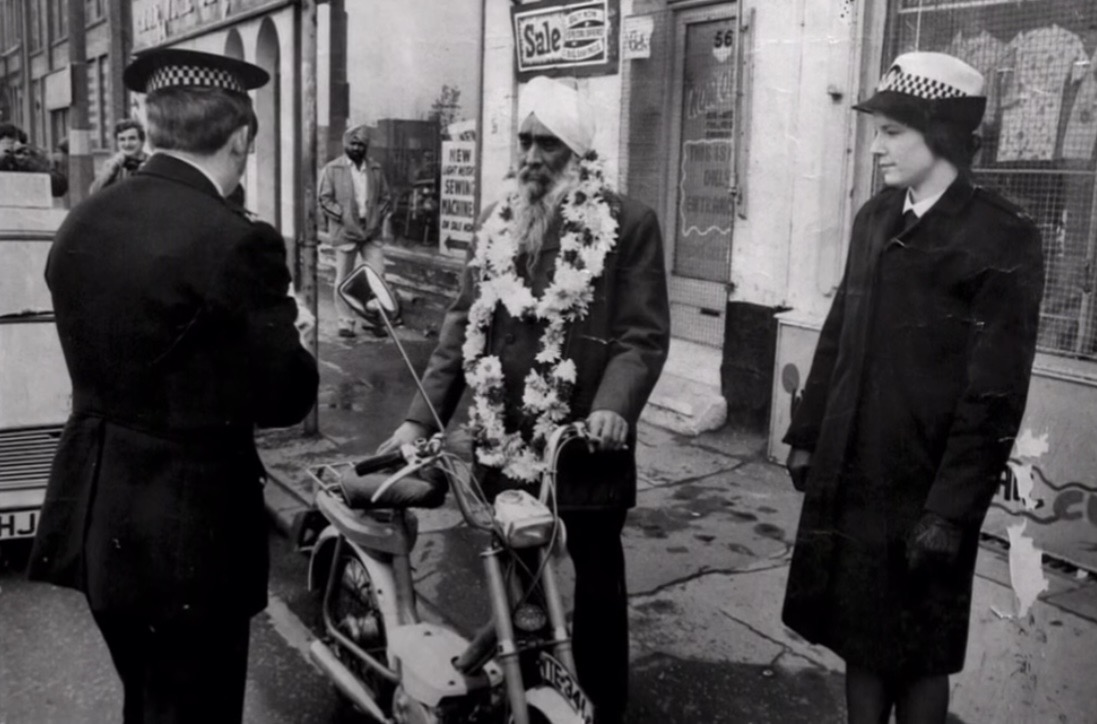
As Sikh communities became more established, community networks developed to provide friendship, practical support and a shared sense of belonging. These connections helped preserve Sikh values and cultural traditions while enabling new generations to participate confidently in British society. Community organisations continue to play an important role in bringing people together and maintaining connections with Sikh heritage.
 Passing the Story to the Next Generation
For the Sikh Motorcycle Club UK, marking the anniversary was as much about education as remembrance. Club founder Kulwant Singh called the 1976 change a “great achievement” and stressed the importance of younger people understanding the history behind rights they have today. The organisation says its work focuses on brotherhood, Sikhi and raising awareness of turbaned riders, while its activities also include charity work and participation in community and remembrance events.
Fifty years on, the sight of Sikh riders leaving the very prison where Gyani Ji had once been held created a powerful full-circle moment. What began with one man’s refusal to choose between his faith and the freedom to ride ultimately contributed to a permanent change in British law.
For younger British Sikhs, the anniversary is therefore about more than looking back. It is a reminder that freedoms enjoyed today were often secured because previous generations were prepared to challenge barriers and stand visibly behind their identity.
Gyani Sundar Singh Sagar refused to remove his turban to conform. Fifty years later, Sikh riders proudly wearing theirs returned to the place where he had been imprisoned, not in protest this time, but in celebration of the legacy he helped leave behind.